
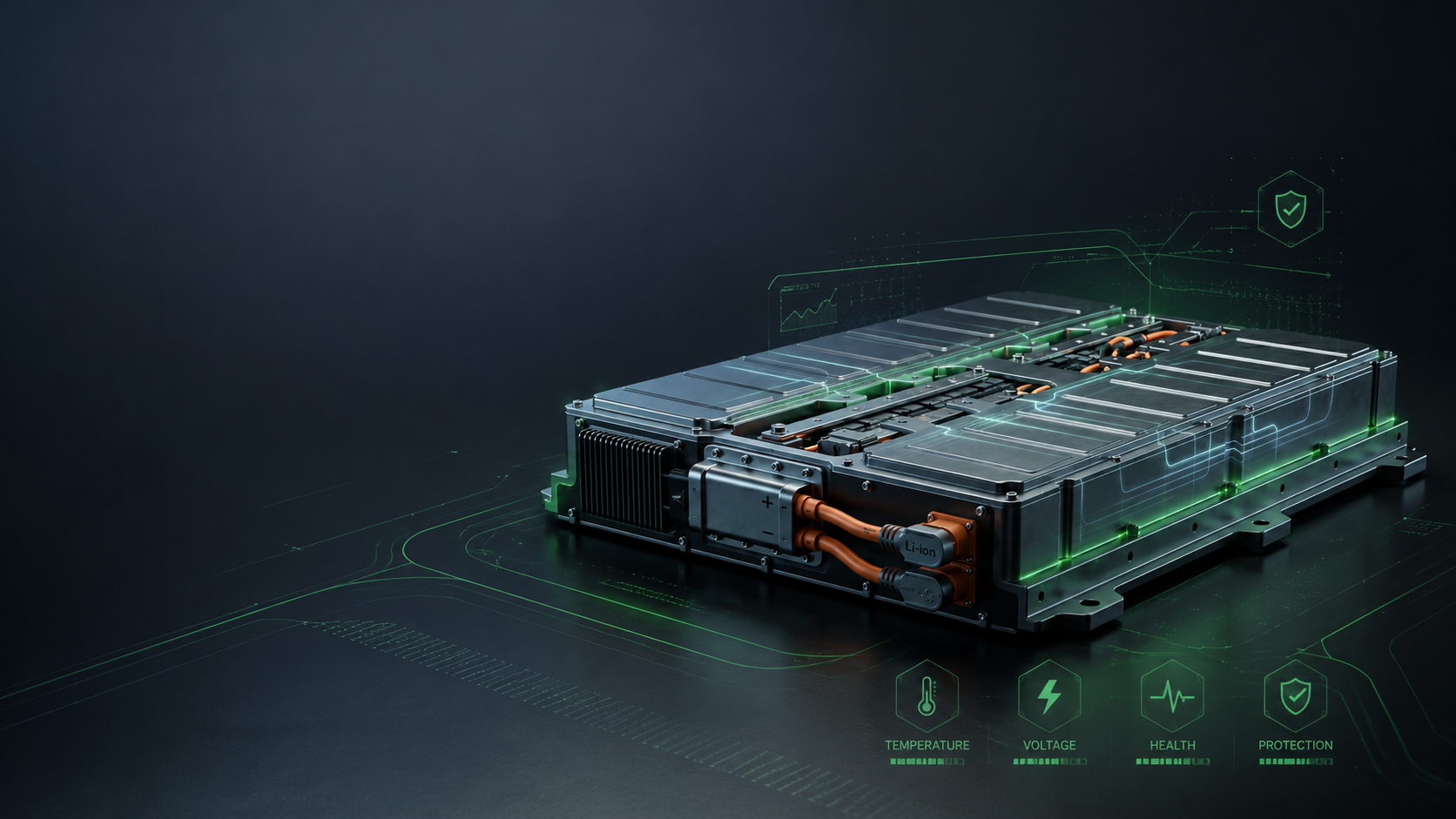
Reliable BMS Hardware and Software for Safer Battery Packs.
CellSafeIQ is a smart battery safety controller that helps reveal the health condition and real-time safety limits of lithium-ion battery packs as they age. Built for battery integrators who need confident safety decisions, not guesswork.
As battery packs age, safe operation becomes harder to verify.
Battery packs are used in transportation, energy storage, and industrial systems where safety decisions directly affect performance, uptime, and risk. As lithium-ion packs age, their health condition and safe operating limits can shift, making it difficult for integrators to know when a pack is still safe to charge, operate, derate, service, or retire.
A pack behaves unexpectedly
During testing or field operation, a pack may show unusual voltage, current, or temperature behavior. The team needs to know whether it is still safe to charge, operate, or deploy.
Safety limits change with age
A battery pack’s safe charging and operating limits can shift as it ages, making fixed limits and offline assumptions less reliable over time.
End-of-life is hard to justify
Without a clear health and safety signal, it is difficult to decide when to derate, service, replace, or retire a battery pack.
When battery safety is uncertain, teams usually protect the system by adding margin instead of using live battery intelligence.
Conservative derating
Reduce charge power, discharge power, or usable capacity to avoid unsafe operation.
Larger safety margins
Oversize the pack or operate below capability because the true safe operating window is unclear.
Expensive validation
Run repeated tests to understand aging behavior, safety limits, and acceptable operating conditions.
Early replacement
Service, replace, or retire packs early when remaining safe operation is difficult to justify.
Reactive updates
Adjust firmware limits after problems appear instead of using live battery condition to guide decisions.
Age-aware safety intelligence framework for existing battery systems.
CellSafeIQ helps battery integrators turn live battery measurements into health-aware safety decisions. The controller uses voltage, current, temperature, and operating data with embedded safety logic to support safer charging, operation, derating, and end-of-life decisions as lithium-ion packs age.
Real-time state estimation
Estimate battery operating states such as state of charge, health condition, safety status, and available operating limits using live voltage, current, temperature, and system data.
Aging-aware limits
Support charging and operating decisions using limits that reflect the battery’s current condition instead of relying only on fixed assumptions.
Degradation and risk guards
Help identify operating conditions associated with accelerated degradation, unsafe charging, or increased safety risk before they become field problems.
Predictable end-of-life & ROI
Use health and safety indicators to support derating, servicing, replacement, and lifecycle planning decisions.
From blind margins to live, defensible limits.
Integrate the controller
CellSafeIQ is designed to support battery systems through the BMS controller layer, helping improve safety intelligence without requiring a full product redesign.
Sense the battery live
Voltage, current, temperature, and operating data feed the controller during charging, discharging, standby, and test conditions.
Compute safe limits
Embedded logic and battery models estimate the safe operating envelope based on the pack’s present condition and operating state.
Act with confidence
Use the controller output to support safer charging, operation, warnings, derating, service decisions, and end-of-life planning.
BMS functions that support safer battery operation
CellSafeIQ combines core BMS functionality with age-aware safety intelligence to help battery systems monitor, protect, communicate, and respond to changing operating conditions.
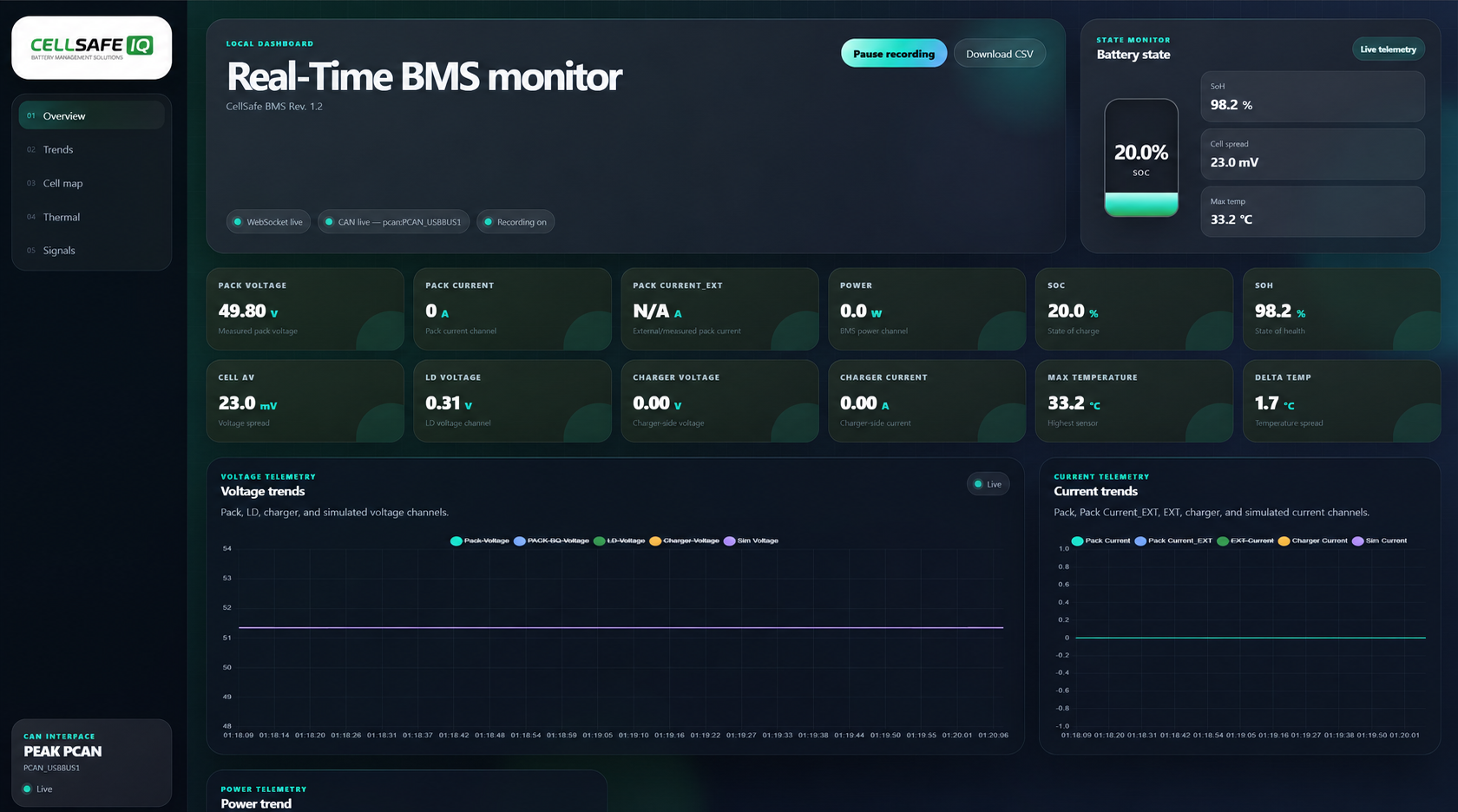
Practical Battery Monitoring Interface
Built for teams that own the battery safety decision.
CellSafeIQ is designed for battery integrators, system developers, and engineering teams that need practical safety insight for lithium-ion battery packs used in demanding applications.
Transportation battery packs
EV, commercial vehicle, and advanced mobility battery systems where charging, operation, and aging must be managed safely.
Energy storage systems
Stationary and grid-support battery systems where degradation, safety, warranty, and uptime are critical.
Battery integrators
Teams that assemble, supply, or validate battery packs and need better visibility into health-aware safety limits.
Testing and R&D teams
Labs and engineering teams evaluating battery behavior, controller logic, and safety performance under different operating conditions.
Put age-aware battery safety intelligence in your next pack.
CellSafeIQ is partnering with battery integrators and engineering teams on demonstration projects. Tell us about your battery pack, application, voltage range, and operating goals so we can help scope the right pilot.